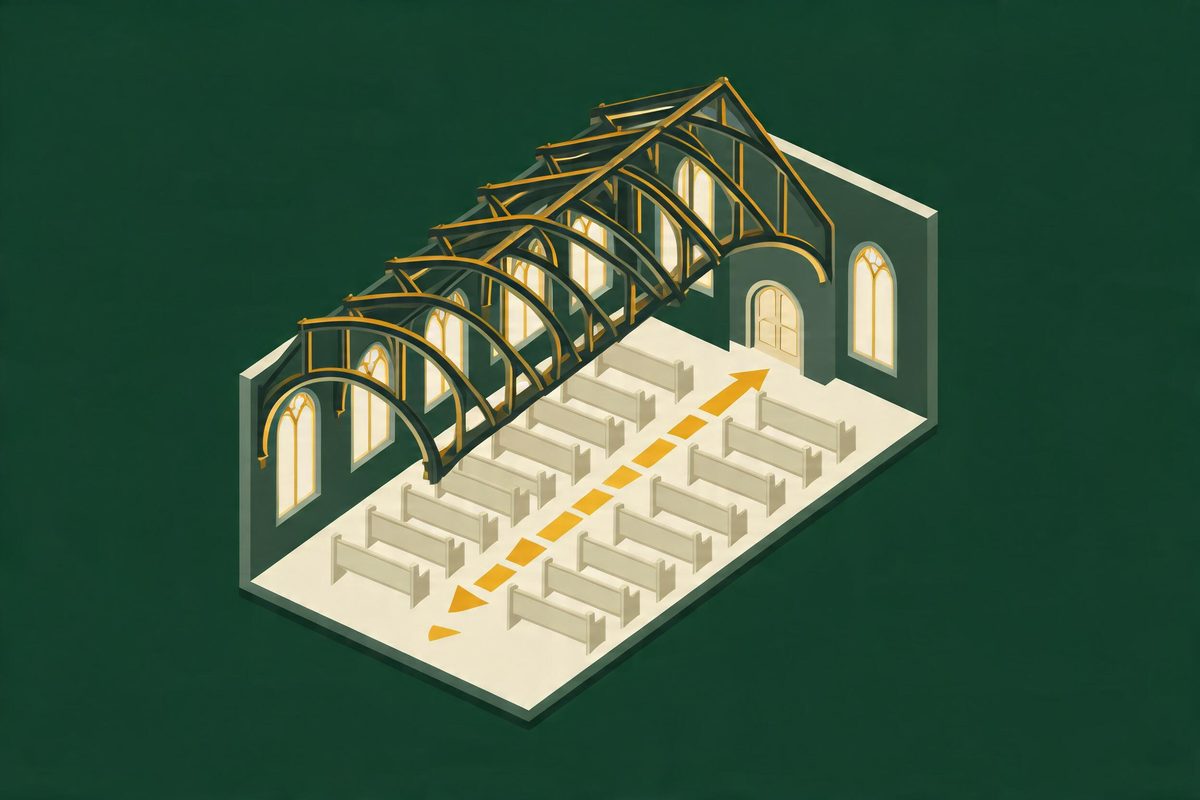
Places of worship and community buildings are among the most commonly overlooked premises in fire safety. They are not workplaces in the usual sense, they are often run by volunteers rather than staff, and many are centuries old. It is easy to assume the rules are different.
They are not. What changes is the practical picture — historic fabric, unpredictable occupancy and public events create risks a standard office assessment never has to consider.
⚖️ There Is No Exemption for Churches or Charities
A church, chapel, mosque, synagogue, temple, village hall or community centre is non-domestic premises under the Regulatory Reform (Fire Safety) Order 2005. The Responsible Person must carry out a suitable and sufficient assessment and act on it. Charitable status, volunteer running and listed status change none of that.
Who Is Responsible?
The duty falls on whoever has control of the premises. For most buildings that means:
- Churches — typically the incumbent together with churchwardens, or the parochial church council.
- Other places of worship — the trustees or management committee of the body that holds the building.
- Village and community halls — the management committee or charity trustees.
- Buildings hired out regularly — control usually stays with the building committee, while hirers must be informed of the arrangements.
Where more than one body has control — a church with a separately managed adjoining hall, for example — the Order requires them to co-operate and co-ordinate. Our guide to the Responsible Person sets out the role in full.
Why These Buildings Are Different
Occupancy swings enormously
A building might hold a handful of people midweek and several hundred at a festival, wedding or funeral. Escape provision has to work at the maximum realistic occupancy, not the average — which is why assessments for these premises normally set a capacity figure and expect it to be observed.
People who do not know the building
Congregations include visitors, elderly people, wheelchair users, families with small children and, at large events, many who have never been inside before. Most will instinctively leave the way they came in, even where a nearer exit exists. Signage and marshalling matter more here than almost anywhere.
Historic fabric and high roof voids
Timber roof structures, open galleries, organ lofts, undercrofts and concealed voids allow fire to spread in ways modern construction does not. There is often no compartmentation to speak of, and a fire in a roof void can be well established before anyone notices.
Naked flame is part of normal use
Candles at services, votive stands, incense, Advent and memorial candles — all routine, all genuine ignition sources near textiles, paper and decorations. The assessment should address how they are supervised, sited and extinguished, not pretend they do not happen.
Heating that is rarely modern
Ageing boilers, gas heaters, electric bar heaters and portable units brought in during cold weather are a recurring finding — often positioned near pew cushions, curtains or stored materials.
Volunteers, not trained staff
There is usually no induction process and no staff handbook. Helpers change frequently and may never have been shown where the extinguishers or the alarm point are.
🕯️ Candles Are Not Automatically a Problem
A competent assessor will not tell a church to abandon candles. The question is control: are they in stable non-combustible holders, a safe distance from textiles and decorations, supervised while alight, extinguished by a named person as part of a closing routine, and reconsidered for higher-risk occasions such as carol services with handheld candles?
Listed Buildings: How, Not Whether
Listed status does not dilute the legal duty. It shapes the solutions:
- Wireless detection avoids surface cabling and disturbance to historic surfaces.
- Upgrading existing doors — intumescent strips, seals and closers — is often preferable to replacing period joinery.
- Discreet signage and emergency lighting that meets the standard without dominating the interior.
- Consents — listed building consent, or faculty for Church of England buildings, may be needed before physical alterations.
An assessment that simply demands modern fittings without regard to the fabric is not much use. The action plan should be achievable in a building that cannot be freely altered.
Hiring the Building Out
Lettings are where community buildings most often come unstuck, because control blurs. Practical steps:
- A written hire agreement covering maximum numbers, escape routes, and who acts as fire marshal.
- A short handover briefing — exits, alarm, assembly point, extinguisher locations.
- Clear rules on candles, staging, decorations, cooking and portable heaters.
- A requirement to keep exits and routes clear, including during setup.
- Consideration of higher-risk events — nativity plays, festivals, catered functions — as separate scenarios.
What Assessors Most Often Find
- Exits secured against theft during services — bolted or key-locked doors that should open freely from inside whenever people are present.
- Storage in escape routes — stacked chairs, tables, decorations and jumble in corridors, lobbies and under stairs.
- No or inadequate detection, particularly in roof voids, vestries, kitchens and boiler rooms.
- Emergency lighting missing in buildings used after dark with little borrowed light.
- Extinguishers unserviced or wrong type for the risk.
- No evacuation plan for disabled visitors, including from galleries and raised areas.
- Assessments years out of date, or predating the October 2023 recording duty.
🔒 Locked Exits Are the Most Serious Finding
Securing a building against theft is understandable — but any exit must open immediately, without a key, whenever people are inside. This is one of the most heavily enforced failings across all premises types. It is solvable with compliant panic hardware; it is not solvable by locking the door.
Insurance and Grant Funding
Specialist insurers of heritage and church property routinely ask for a current fire risk assessment, and will examine it after any claim. Grant-giving bodies funding repairs or reordering frequently ask for one too. Having a current, properly recorded assessment is usually the difference between a straightforward process and an awkward one.
📋 How We Approach These Buildings
A certified assessor attends, surveys the building including roof voids and ancillary rooms where safely accessible, and produces an RRO 2005-compliant written report with a prioritised action plan — sympathetic to historic fabric and realistic for a volunteer-run organisation. Delivered within 48 hours of the visit. Fixed-fee quote within 2 hours of your enquiry; most churches and halls fall within the usual £250–£500 + VAT range, with larger or more complex buildings quoted individually. See our dedicated fire risk assessment in Manchester page for local coverage and booking.
Where to Start
If you are on a PCC, a management committee or a board of trustees, three questions will tell you where you stand: who is recorded as the Responsible Person, when was the assessment last reviewed, and have its actions been completed with evidence.
If the assessment predates the October 2023 recording duty, exists only as notes, or nobody is quite sure who holds the duty, that is the place to begin.